
Time to re-think ‘workplace health’

Something has really been bothering me recently about ‘workplace health’ initiatives.

We seem to have got into a real mess about the PURPOSE of this type of focus.

The employer perspective is of the importance of PRODUCTIVITY and the WASTAGE caused by people being ill or off work.    As a result the initiative’s success is measured in terms of sickness absence, rather than in terms of employee wellbeing as a positive condition.  The questions shifts from – what can we do to enable people’s wellbeing? (the salutogenic perspective) to – what can we do to stop people being off-sick? (the pathogenic perspective).  Back to the use and abuse of measurement issue – what we get is a punitive system that performance manages levels of sick leave and game playing starts – people take annual leave or use flexi time, rather than reporting a sick day.  Or presenteeism – people coming to work and pretending to work even when they are not fit to be there, perhaps passing on infections to colleagues in the process. Recorded sick leave goes down, employers herald this a success, but the wellbeing of the workforce has not improved.  Public health professionals are complicit in this, they make the case for workplace health initiatives in terms of the cost of days work lost.

The other thing that bugs me is that workplace health initiatives purely see the workplace as a site of health promotion or traditional public health ‘lifestyle’ interventions.  We use the workplace to tell people about the importance of eating 5-a-day but then don’t give any thought to whether or not they can get affordable healthy food during their working day.  We use the workplace to train people in emotional resilience – telling them they have to be resilient to stress – this means that if they go off with stress it becomes the employees fault for not being resilient enough (nothing to do with workplace stressors at all!).  So in essence we are telling people to be healthy and happy (and therefore productive and not waste employer’s resources) but give very little thought to the physical, social and economic conditions in which they are doing their work.

The bottom line is – we need to re-think workplace health. Continue reading
Paradigm shift

I saw a tweet recently that said something like “you know when someone says paradigm shift that it is going to be a long meeting”.  No idea how long this blog will be – wanted to pull a few strands of thought together.

The thoughts were prompted by a friend of mine pointing me in the direction of a great on-line essay by Charles Eisenstein – called 2013: The Space between Stories.  It really cleverly describes something I’ve experienced both as a ‘citizen’ and also in my ‘work’.  I highly recommend that readers follow the link above now to get a sense of Eisenstein’s essay that starts:

Every culture has a Story of the People to give meaning to the world. Part conscious and part unconscious, it consists of a matrix of agreements, narratives, and symbols that tell us why we are here, where we are headed, what is important, and even what is real. I think we are entering a new phase in the dissolution of our Story of the People, and therefore, with some lag time, of the edifice of civilization built on top of it.

In fact if you’ve only got a few minutes, read that blog not this one!

Continue reading

Reflections on the bookshelf

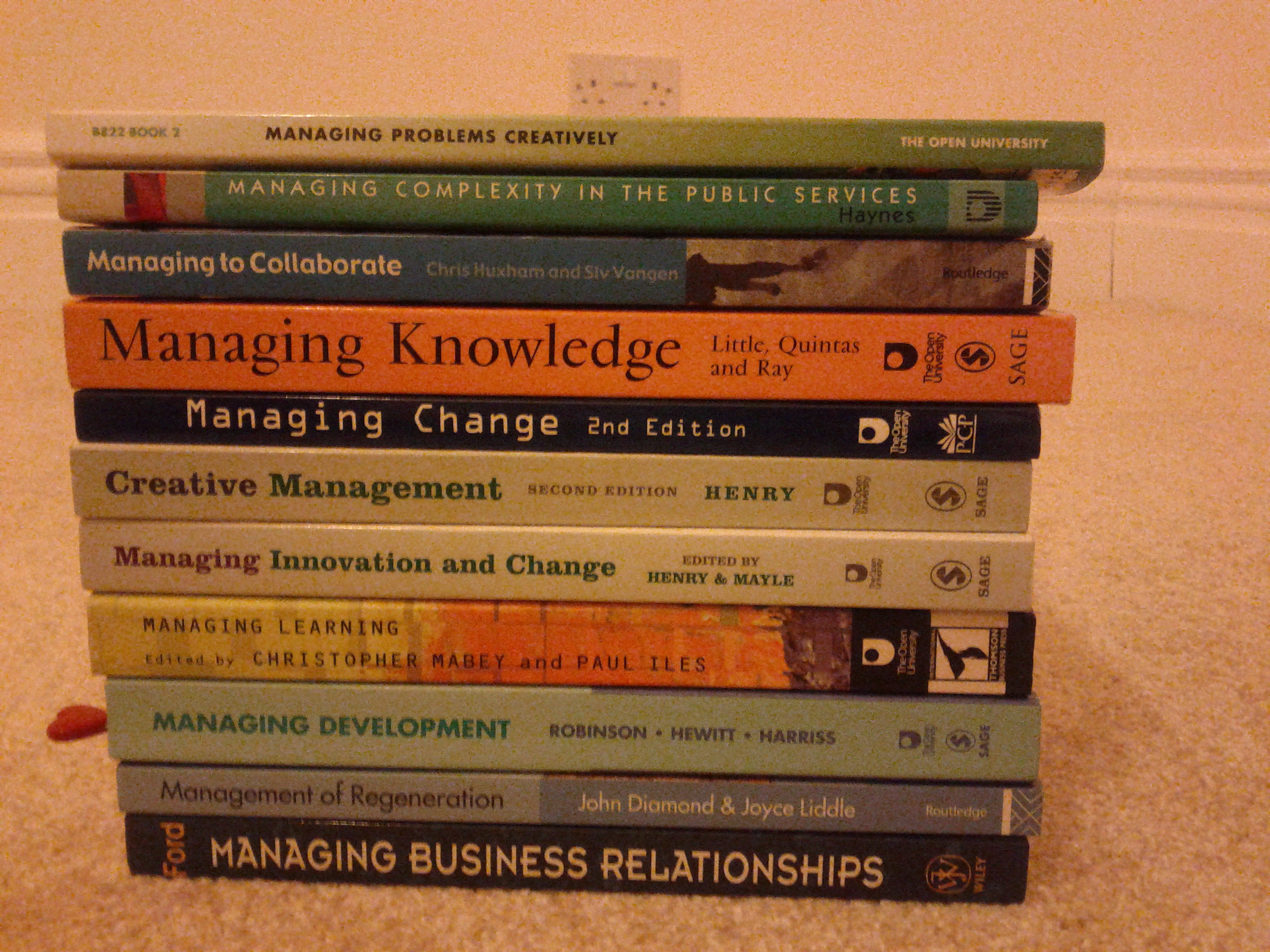
The bookshelfWe’ve just been having our dining room redecorated and recarpeted to make it into a better study/office and not a dining room.  This means I have had to carry all the contents of our bookshelf upstairs (two weeks ago) and back down again (today).

Now bearing in mind, this household has two OU MBAs – gained through slightly different elective routes – plus my MSc STiP.  I started to realise just how many books we have with ‘managing’ or ‘management’ in the title. Continue reading

The use and abuse of measurement

There seems to be a bit of a thing going on this week about terms like measurement, targets, payment by results, outcomes.  It has been going on a while in conversations I have had (both face to face and on-line) and a number of systems bloggers are writing about it but it all seems to be getting a bit busier this weekend…it seems to be coming to a head.

So to start with I’ll mention all the activity that has prompted me to turn to the keyboard to add to the conversation – or if not adding to it then at least summarising where my own thinking is going to. Continue reading

The lens of collaborative governance

One of the threads of academic discourse I have accrued papers on as I have been doing the ‘literature reviewing’ work referred to in my last post is that of “collaborative governance” – a recurring theme in public administration theory and research.  As my first in-road, I decided to read the most recent paper in my list – I figured that the new stuff will build on the shoulders of the old stuff so even if I don’t feel particularly inspired by the new stuff – at least I have a feeling of the names of the people who write about this stuff.  So the top of the pile (that is speaking figuratively, coz it’s all electronic) was a paper published in January 2012 (a year ago) by Emerson et al – called “An integrative framework for collaborative governance”.

It took a while to get used to the language – lots of familiar words, being used with particular nuances.  I read it, read it again and then started realising just how helpful it is to me in my work (yes, distracted from my journal article per se but nevertheless useful and interesting).  Perhaps it is the ‘integrative’ nature – in that it pulls on a wide range of other writing.  Perhaps it is the ‘framework’ side – hey, I love a theory, particularly one that comes with a diagrammatic conceptual model.  But I feel I’ve come across a gem.

Continue reading

Writer’s block

You’ll see I haven’t been blogging much recently.  It’s not that I haven’t been doing any thinking or reading – just that none of it is coherent enough to rally together into a blog post.  It’s a little weird not having the rigour of an academic course to say – read this, think about it, reflect it back in assignments – at least the academic courses gave me a route, a journey to follow, and a timetable.  Sure I did little forays every now and again – up interesting cul de sacs and detours, but the main journey was charted for me and I could see what it was to make progress. Continue reading

Change again…

I have been thinking a lot about change recently.  I have got this muddled mess in my head about it.  But as I sat down to write this blog, I realised I have been here before…

30/10/10 – one of my first ever blogs – The nature of change

12/11/10 – not long after Changing practice

27/12/10 – Worldviews and theories of change

14/3/11 – Managing systemic change

I think my latest quest perhaps has more to do with ‘managing’ change, rather than change per se.  I think it was in B822 Creativity, innovation and change that the following approaches to change were laid out: Continue reading

On helping – review and moving on

Can’t believe nearly a month has gone by since my last blog… but hey it is supposedly ‘summer’ and there has been the distraction of the olympics.  But I thought I’d better return to my inquiry into helping..

There are a number of other chapters in Schein’s book after the one on humble inquiry, but they are more about applications of the ideas covered in all the blogs to date, rather than new information.  Continue reading

On helping – the art of humble inquiry

Having made the case that it is most appropriate to start out as a helper in the role of process consultant (the what and the why), Schein goes into humble inquiry – as the ‘how’ of being a process consultant.

Humble inquiry helps to do three key things – firstly, equalise the relationship by making what the client knows become all important; secondly, shows that as the helper you are attentive and interested in the client’s situation; and finally, it helps get more information and remove some of the ambiguity and unknowns from the situation so that as the helper you have more of an idea of what to do next. Continue reading